Every eighteen months, a tech journalist with an empty calendar publishes the exact same column:
"The Tragic Death of RSS: How Big Tech Murdered the Open Web When Google Killed Reader in 2013."
Let’s be brutally honest: Google didn't murder RSS. Google merely locked the front door of one particular clubhouse, and millions of tech users voluntarily threw their hands in the air, walked into the nearest corporate surveillance casino, and plugged an algorithmic IV drip directly into their jugular veins.
You didn't lose RSS. You surrendered it in exchange for dopamine slot machines.
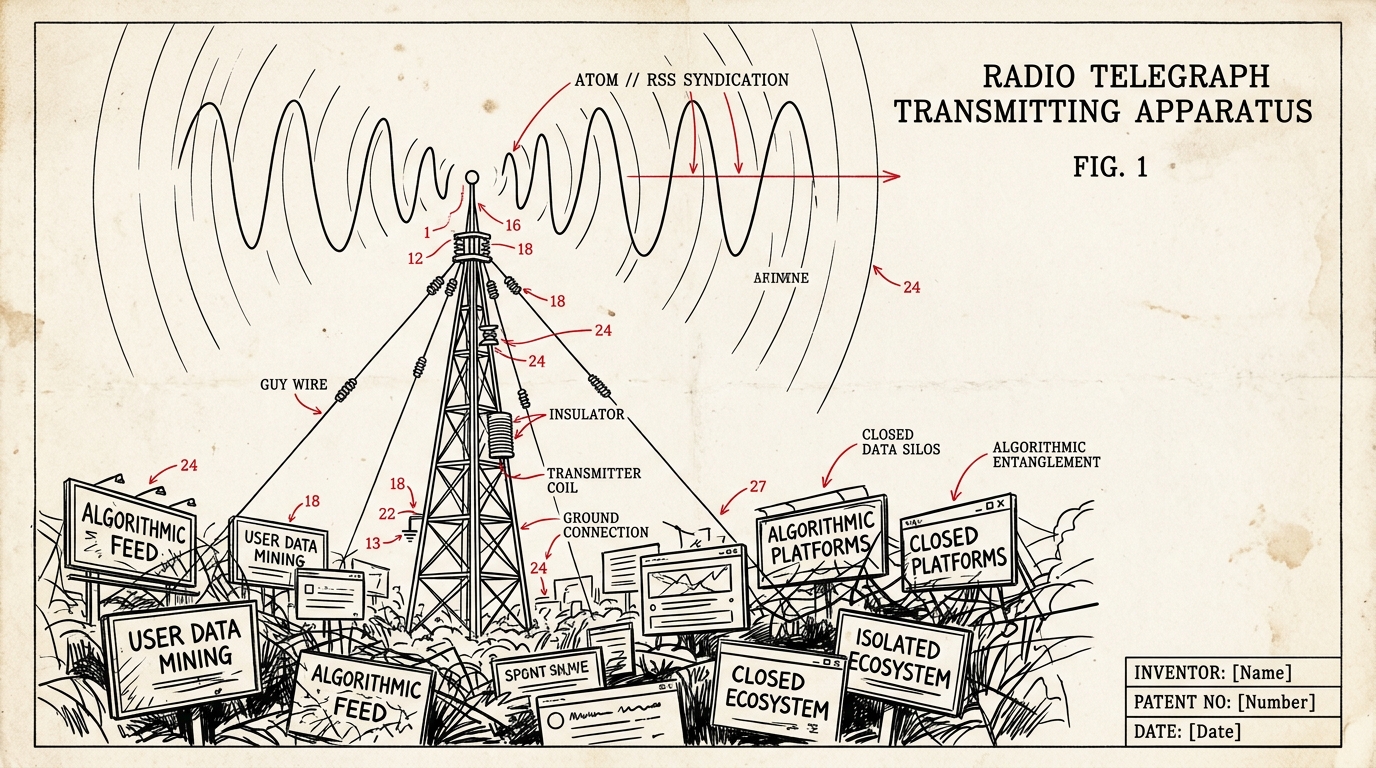
What You Traded It For: A Quick Inventory
Consider the digital sewage plant you currently use to consume information:
- Twitter / X: A post-apocalyptic Thunderdome where blue-check-verified accounts fight to the death over whether drinking lukewarm tap water makes you a communist or a venture capitalist.
- LinkedIn: The ninth circle of professional hell, where somebody watches their golden retriever trip over a garden hose and turns it into a 14-paragraph inspirational epic:
"What my dog's sprained ankle taught me about enterprise sales agility, cross-functional synergy, and why you should hire my consulting agency."
- Instagram & TikTok: You open the app to see a photo of your nephew’s birthday party. Three hours later, you are staring blankly at a video of a guy in an apron deep-frying an entire wheel of cheddar cheese while techno music blares at 140 BPM.
In every single one of these platforms, an engagement algorithm—trained on petabytes of psychological vulnerability data—is actively deciding what information enters your conscious mind.
Its sole optimization metric is not your education, your happiness, or your enlightenment. It is: "Can we keep this hairless ape staring at this glass rectangle for another twenty-seven seconds so an ad agency can bill Procter & Gamble $0.003?"
========================================================================
THE ALGORITHMIC ENGAGEMENT TRAP:
[Human Writes Thought]
        |
        v
[Algorithm Injects Outrage Filter + Ad Bids]
        |
        v
[You receive 1 post + 4 sponsored posts about crypto mattresses]
========================================================================
THE BORING, GLORIOUS ATOM / RSS BROADCAST:
[Machine/Human Writes Thought] ---> [XML File on Disk] ---> [Your Reader]
(Zero algorithms. Zero ads. Just words. Your blood pressure drops 15 points.)
========================================================================
The Superpower of the Boring Orange Icon
Here is the revolutionary, mind-melting secret of RSS that modern Silicon Valley product managers cannot comprehend:
An RSS feed does not care about you.
- It does not push a notification to your smartwatch vibrating with: "Three people you barely know just shared a thought! Open the app now!"
- It does not rank posts based on how many people are currently yelling at each other in the comments section.
- If you don't open your RSS reader for three weeks, it doesn't send you a passive-aggressive guilt-trip email titled "We miss you, stranger! Here’s what you missed!"
It just sits there like an obedient, well-behaved digital butler. When you want to read, you open it. When you are done, you close it. The list reaches zero, and your life resumes.
Reclaim Your Sanity
This website publishes a 100% synthetic, unadulterated Atom feed at /atom.xml.
Copy that link. Paste it into an honest reader—whether you like terminal tools like newsboat, desktop classics like NetNewsWire, or self-hosted web engines like Miniflux.
Step off the algorithmic hamster wheel. Take back your frontal cortex. And for the love of all that is decent in computing, go put the kettle on.